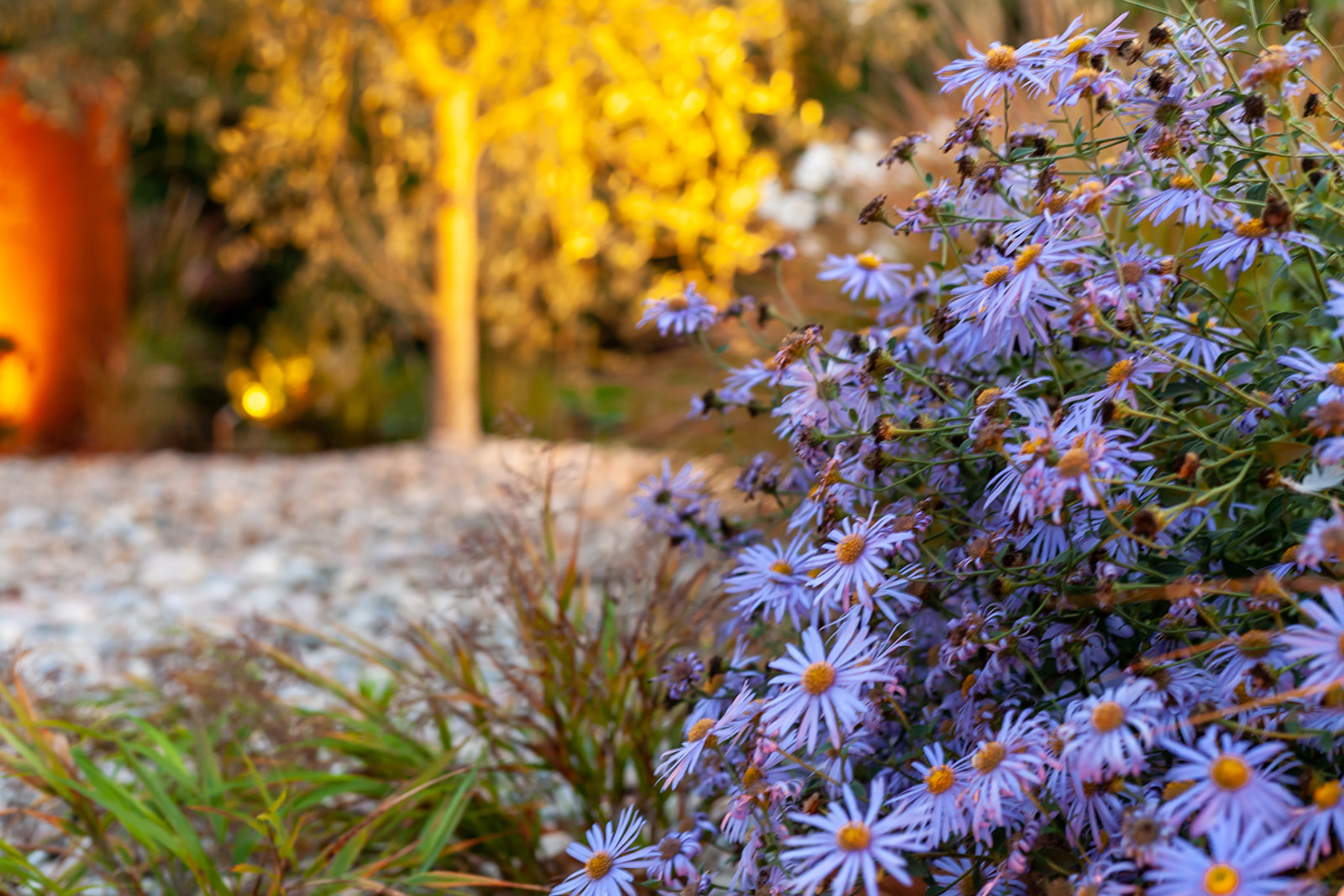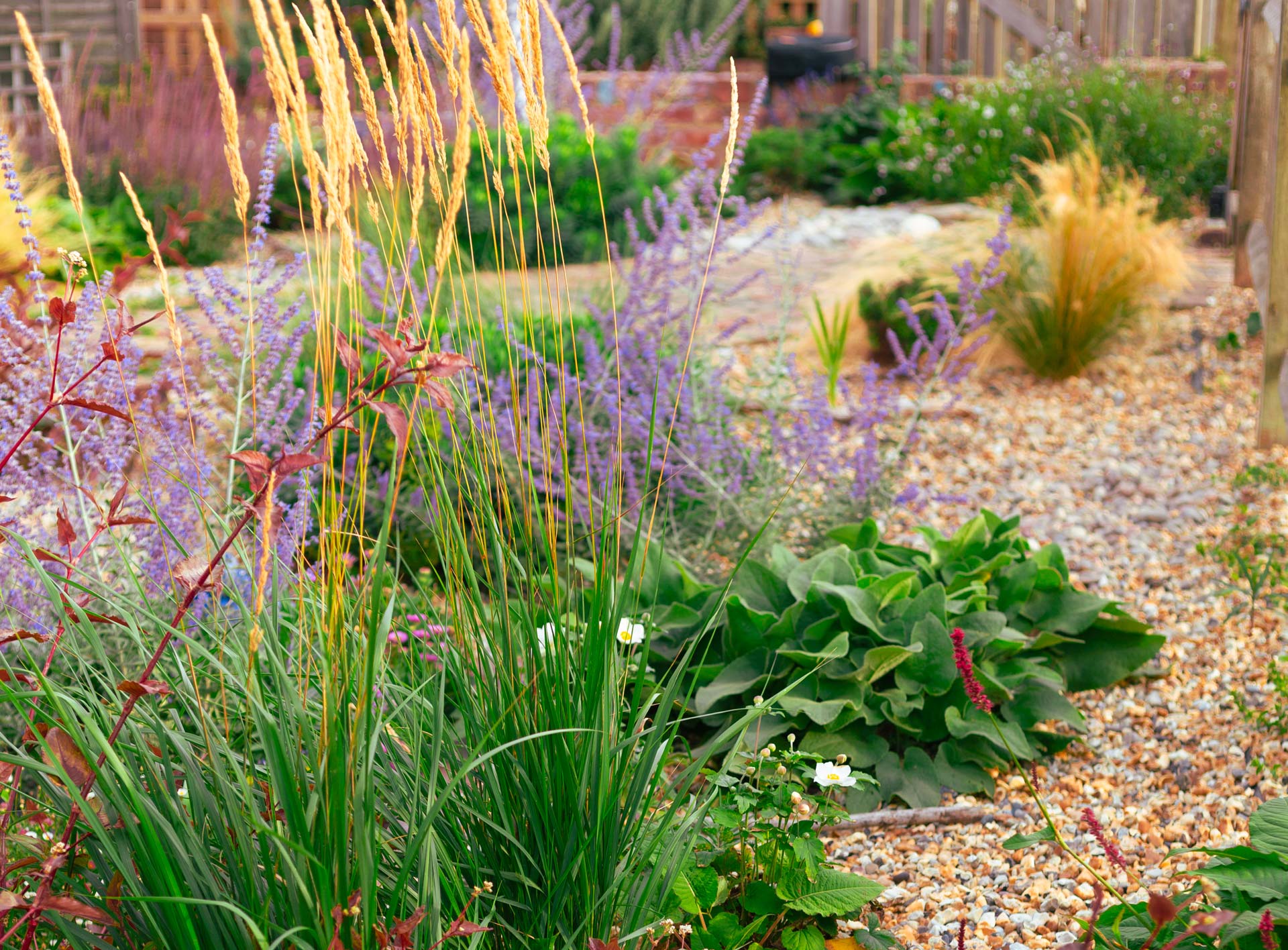

I like looking at gardens in October because you begin to see things that were much easier to miss during summer.
In June, a garden can get away with quite a lot. Borders are full, roses are flowering and there’s green everywhere. By October, some of that has gone. Perennials are finishing, the lawn might be looking tired and plants that dominated earlier in the year have started to disappear back into the border.
What I tend to notice now are the things underneath all that summer colour. A tree with a really good shape. A hedge giving the garden some weight. The line of a path through the planting. A pergola that still holds the space together. Grasses that seemed fairly insignificant earlier in the year but suddenly look wonderful in the lower afternoon light.
It’s also a good test of the planting. I don’t expect borders to be packed with flowers in October, and I wouldn’t particularly want them to be. What interests me more is whether there’s still enough going on once those flowers have faded. Foliage, seed heads, grasses, shrubs and the shapes of the plants themselves all start to matter more.
Some gardens manage that change really well. Others suddenly feel rather bare, and it isn’t always solved by adding a few more autumn-flowering plants. Sometimes there simply isn’t enough structure underneath the summer display.
That’s the part of autumn garden design I find interesting. You start to see what has been doing the work all along.
Flowers Aren’t Really the Point
I remember visiting one garden a couple of years after we’d finished the planting. It was October and, if you’d counted the flowers, there probably weren’t that many. A few asters were still going, the hydrangeas had started changing colour and most of the summer display had settled down.
What struck me wasn’t any individual plant. It was that the garden still felt comfortable. The pergola had become part of the planting instead of sitting on top of it, the borders had softened around the paving and the trees looked as though they had always been there.
Nothing was shouting for attention. It just worked.
I think that’s what people often mean when they say a garden feels established. It isn’t simply that everything has become bigger. The separate elements no longer feel quite so separate.
I’ve noticed the same thing when looking back at photographs of older projects. Newly completed gardens can be rather neat. Shrubs are smaller, plants sit politely in their allotted spaces and every edge is clearly defined. Give the same garden a few years and things begin leaning into one another. Climbers soften structures, planting reaches the edges of paths and everything relaxes a little.
Personally, I prefer it that way.
It’s one of the reasons the planting stage matters so much when I’m developing a planting design. I’m interested in what the garden will become, not simply how it will look when the plants first go in.
The Garden Starts to Show Its Bones
By October, I tend to notice the shape of a garden more than I did a few months earlier. There’s simply less competing for attention.
A path that almost disappeared beneath planting in June is suddenly much easier to see. The same goes for walls, steps, hedges and pergolas. They were always there, of course, but once the borders begin to settle back, those harder lines become part of the picture again.
This is where a garden can start to feel either well held together or a little exposed. If all the interest was coming from summer planting, October can feel quite abrupt. If there’s a decent structure underneath it, the change feels much softer.
Trees help enormously with that. So do shrubs with a good shape, evergreen planting, hedges and anything else that still gives the eye somewhere to rest. I’m not looking for the garden to stay green or polished. I just don’t want it to feel as though everything has vanished at once.
The same applies to hard landscaping. I notice whether a path still leads somewhere worthwhile, whether a seating area still makes sense once the planting around it has thinned and whether a pergola or wall still feels connected to the rest of the garden.
You can see this relationship between structure and softer planting in several of my completed projects. In the Winding Rocks garden, for example, the pergola, pond, timber and planting all have different jobs to do. The planting changes; the framework remains.
Summer can hide quite a lot. Autumn tends not to.
Looking at a Garden With Fresh Eyes
One of the nicest parts of my job is going back to gardens a few years after they’ve been finished.
The photographs are always different. Plants have found their space, climbers have reached the tops of pergolas and shrubs have grown into one another. The garden no longer feels newly planted; it feels settled.
I’m not looking for perfect borders or flowers in every corner when I go back. I’m much more likely to notice whether the planting has softened the paving, whether a tree has begun to frame a view or whether the different parts of the garden still sit comfortably together.
Sometimes there will be something I’d almost forgotten. A shrub that has finally reached the size we hoped for, perhaps, or a young tree that now casts enough shade to change how that part of the garden is used.
The owners may barely have noticed the difference. They’ve watched it happen a little at a time.
I might turn up after three or four years and immediately see that somewhere which used to sit in full sun is now considerably more sheltered. Or that a climber which once looked rather lonely against a pergola has become part of the structure.
That isn’t something going wrong. It’s simply what gardens do.
It’s also why I don’t think of a garden as a finished object. The original garden design gives it structure and direction, but plants keep growing and people keep living in the space afterwards.
What Autumn Planting Actually Needs to Do
I don’t think the answer to a flat-looking October garden is necessarily more October flowers.
Sometimes that will help. Often it won’t.
I’m more interested in the mix. There might be a grass that has barely been noticed all summer but suddenly looks wonderful against fading hydrangeas. Seed heads can remain useful long after their flowers have gone. A dark evergreen nearby might make both look better.
That doesn’t mean leaving everything standing simply because it’s autumn. Some plants collapse and look awful. I’ll happily remove those. Others become more useful once they dry out and their shape becomes clearer.
It’s a judgement rather than a rule.
This is something I explored in more detail in How Planting Shapes a Garden Through the Season. Planting that works across a year is less about making sure something is always flowering and more about making sure the border doesn’t lose all of its shape at once.
A garden also doesn’t need to be large for this to work. In a smaller space, every plant simply has to earn its place a little more. A small tree can provide structure, privacy and seasonal change. Climbers can soften boundaries without taking up much ground. A handful of well-chosen shrubs can do more than another border filled entirely with short-lived colour.
And if the basic layout of an existing garden already works, there may be no reason to redesign the whole thing. Sometimes changing the planting is enough. An established patio, path or tree might be perfectly good; it’s the planting around them that has become tired or unbalanced.
October Is Also a Good Time to Think Ahead
One thing that does surprise people is how many conversations about new gardens begin in autumn. Spring seems like the obvious time, but by October you’ve just spent another summer living with the space.
You know whether the main terrace actually got used. You know where the evening sun disappeared, whether the screening was enough and which parts of the garden everyone naturally gravitated towards.
Clients will sometimes say, “We’ve lived with it for another summer, and…” before stopping to think.
That pause is usually useful.
You don’t need to know how to solve everything. Knowing what you enjoyed, what irritated you and which parts you barely used is already a perfectly good starting point.
It also gives you time. A considered garden project involves far more than choosing plants, and starting the conversation during autumn or winter gives the design process room to develop before everyone suddenly wants their garden ready for summer. I’ve written separately about the best time to start a garden design project.
October doesn’t make me want to write a long list of things that need fixing.
Mostly, it makes me look.
At what’s still working. At what has disappeared. At the parts of a garden that seemed quite ordinary in June but are suddenly doing much more of the work.
And I think that’s probably enough.