
I think it’s quite easy to forget about lighting when you’re planning a garden. There’s usually so much else to consider, from the layout and materials to the planting, that what happens after dark can get left until much later.
But I always like to think about it while the garden is still being designed. Not because I want to light up every corner, quite the opposite. Sometimes it’s the areas you leave in darkness that make the lighting work.
In one of my gardens, we have an oak pergola with festoon lights hanging between the beams. Beneath it is a seating area surrounded by planting, with a timber deck crossing a pond in front. The lighting isn’t particularly complicated, but I love the warmth it brings to that part of the garden. You can imagine sitting there on a summer evening, and even when nobody’s outside, it’s a lovely view back from the house.
Of course, what works in July isn’t necessarily what you want in December. The garden changes, the evenings change, and so does the way we use the space. I think that’s what makes lighting an interesting part of garden design. It’s not simply about where to put the lights, but what you want to see, and when.
A Garden Worth Looking at in Winter
By the time November comes around, most of us aren’t spending much time sitting outside in the evenings. But that doesn’t mean we stop enjoying the garden. We just tend to look at it from somewhere warmer.
I think this is something worth considering when you’re designing a garden. Where are the main windows? What can you see from the kitchen or sitting room? There’s not much pleasure in looking out at a completely black space every evening, particularly when you’ve spent so much time creating a lovely garden.
Trees can be wonderful when they’re lit from below, especially once they’ve lost their leaves. You begin to notice the shape of the branches and the structure of the tree itself. Evergreen shrubs can work well too, and I particularly like the effect of light catching the finer leaves and stems of ornamental grasses.
You don’t need to illuminate everything. In fact, I’d rather see one or two features picked out against the darkness than a whole garden lit up like a showroom. It’s much more interesting when your eye has somewhere to settle.
There are practical things to consider as well. Paths and steps need to be safe, particularly during the wetter months, but the lighting doesn’t have to be harsh. Low-level lights can make a route easier to follow without becoming the first thing you notice when you look outside.
And of course, we need to remember the wildlife. I wouldn’t want a garden permanently illuminated throughout the night. Using timers, keeping light levels low and leaving darker areas undisturbed are all worth thinking about, particularly where there are trees, hedges or ponds.
Making the Most of Summer Evenings
There’s something lovely about being able to stay outside long after dinner, especially when we’ve had one of those warm days and the garden is still holding onto the heat.
In one of my projects, an oak pergola sits above a small seating area, surrounded by planting. We hung festoon lights between the beams, which give off a lovely warm glow without being too bright. There’s a timber deck crossing the pond in front, with smaller lights set into the surrounding structure.
What I like about this space is that the lighting feels part of it. The pergola gives the seating area a sense of enclosure, and the lights make it somewhere you’d happily settle for the evening. The planting softens everything around it. Even the timber screening at the back looks quite different once the lights are on.
When I’m planning an outdoor dining or seating area, I try to imagine how it will actually be used. You need enough light to see what you’re eating, of course, but nobody particularly wants a bright spotlight shining down on the dinner table. A softer light above, perhaps with a little lighting around the edges, is usually much more comfortable.
Spring is slightly different. The evenings can still be chilly, but the days are getting longer and people are beginning to venture outside again. It’s a good time to check that the lighting is still doing what you want it to do. Plants grow, climbers spread, and a light that worked perfectly the previous summer might now be hidden behind a shrub.
I also like being able to switch different parts of a garden on and off independently. You might want the seating area lit while you’re outside, but only a few lights left on afterwards. It gives you more flexibility and means the garden doesn’t have to look the same every evening.
Seeing Plants in a Different Light
I particularly like lighting trees, although you have to be careful where you position the fittings. Get the angle wrong and you can end up with a rather harsh effect, especially on trees with a dense canopy. I prefer to pick out the shape of the trunk and branches, leaving some of the tree in shadow.
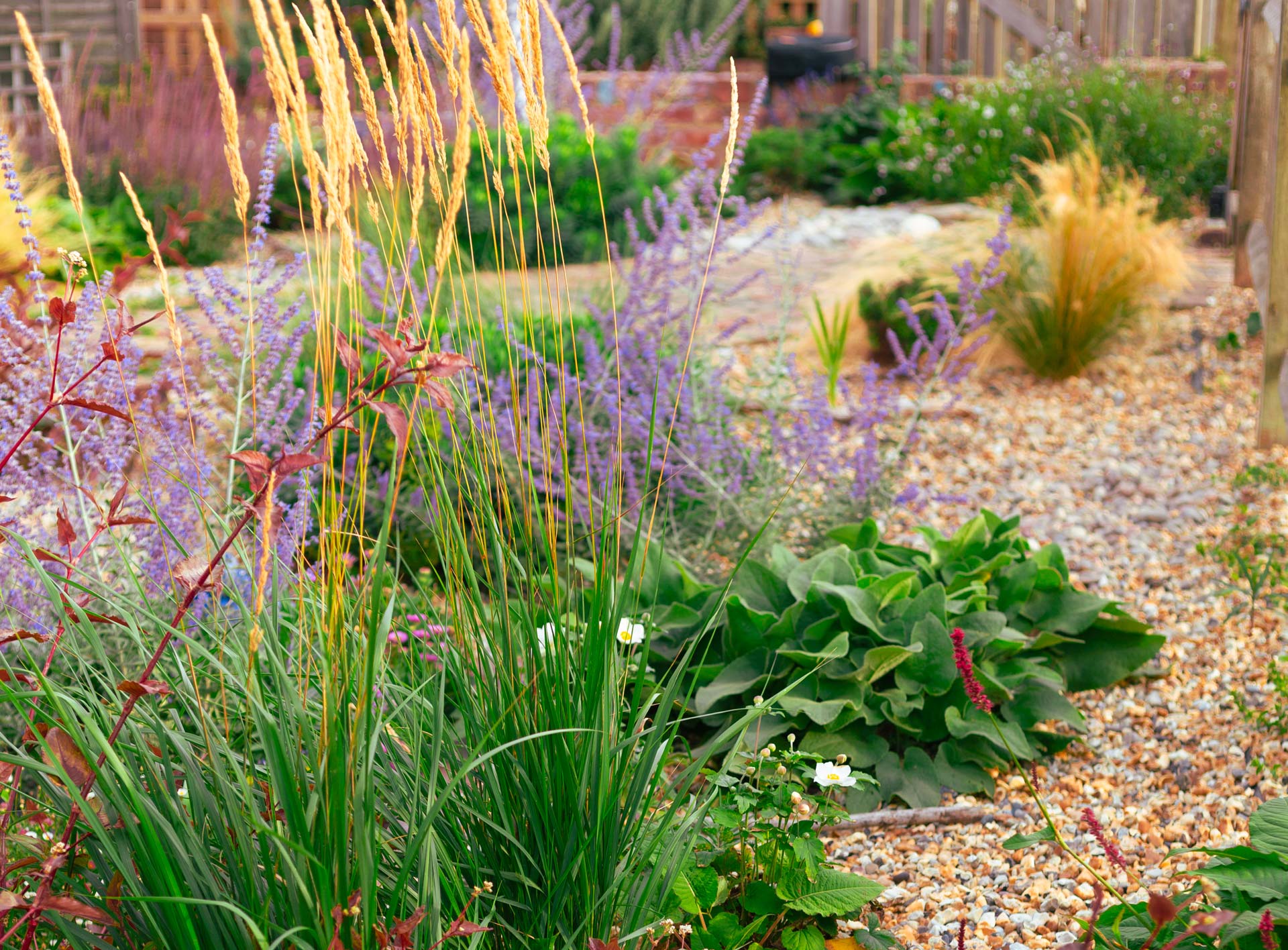
Grasses are lovely with light coming through them. Miscanthus, for example, has those tall, feathery flower heads that catch the light beautifully towards the end of summer and into autumn. The same goes for plants with fine, open stems. You can get some wonderful effects without needing very much light at all.
In one of my gardens, we have purple asters growing in front of a tree that’s illuminated further back. It’s a combination I really like, particularly at this time of year when the asters are still flowering. The warm light behind them brings a little depth to the border, but there’s plenty of darkness left around the planting.

I also have to think about what happens as the garden matures. A light that works perfectly when a tree is first planted might be completely hidden a few years later. Sometimes it’s simply a matter of adjusting the angle or moving a fitting, which is why access is important.
With paving and stonework, I’m generally more interested in a little light grazing across the surface than having everything brightly illuminated. It shows up the texture without drawing too much attention to the lighting itself. Timber can look particularly warm in the evening, as you can see in the pergola garden.
Water is another consideration. Reflections can be lovely, but I tend to be quite restrained with lighting around ponds. Apart from the visual effect, there’s the wildlife to consider, and I wouldn’t want bright lights shining into the water throughout the evening.
Lighting Paths and Steps
It’s surprisingly easy to overlook a step when you’re walking through a garden at night, particularly if the paving is all the same colour. I tend to pay quite a lot of attention to changes in level when I’m working out where the lighting should go.
I’m not a great fan of having a light every metre or so along a path. Apart from anything else, you end up noticing the fittings rather than the garden. I’d much rather use a few well-placed lights where they’re needed, perhaps with some light spilling across from the planting alongside.
In one of my smaller gardens, there’s a paved path winding between borders filled with grasses and flowering perennials. The lighting is tucked into the planting and towards the back of the garden. I like the way it catches the taller stems and leaves parts of the border in shadow. You can still make out where you’re going, but it doesn’t feel like a brightly lit walkway.

The position of a fitting can make quite a difference. If it’s too high, or pointing towards you as you approach, it can be uncomfortable to look at. With steps, I prefer to keep the light low and make sure the edge is visible. You also have to think about where people will be standing or sitting, as a light that looks fine from one direction can be quite glaring from another.
Then there’s the rather less glamorous business of getting the cables in. It’s much easier to plan this while the paving and walls are being built than to come back and disturb everything afterwards. I mark the lighting positions on my plans so the electrician can allow for them before the landscaping is finished.
And I always try to choose fittings that don’t stand out too much in daylight. After all, for most of the year you’re going to be looking at the garden with the lights switched off.
Getting the Lighting Right from the Start
There’s nothing more frustrating than finishing a lovely terrace and then realising someone wants lights fitted into the steps. By that point the paving is down, everything’s been pointed and nobody particularly wants to start pulling it apart again.
That’s why I include lighting in my garden plans. It doesn’t mean deciding on every last fitting straight away, but I do need to know where the power will be needed and which parts of the garden we’re likely to illuminate.
Sometimes the best position for a light isn’t where you’d expect. You might want to pick out a beautiful tree, for example, but there’s no point putting a spotlight where it will shine straight into someone’s sitting room. These are things I look at when I’m working through the layout, rather than leaving them until the garden is finished.
I also like to keep things fairly simple when it comes to switching the lights on and off. There’s little point having every light in the garden come on together when you only want to sit beneath the pergola for an hour. Separate controls give you the choice, and timers can be useful too.
And it’s worth remembering that plants don’t stay the size they were when they went in. I’ve seen plenty of lights disappear beneath shrubs as gardens mature. Leaving room to reach and adjust the fittings makes life easier, particularly in borders where the planting is quite full.
The electrician will deal with the installation, of course, but knowing where the lighting needs to go is part of getting the garden design right. I’d much rather have those conversations before the landscaping starts than when everyone’s packing up to leave.
Hello Darkness, My Old Friend
There’s a temptation to light every corner of a garden, particularly when you’ve spent a lot of time and money making it look beautiful. But darkness has its place too, and sometimes I think we forget that.
It’s something I bear in mind when designing gardens with established trees, hedges and ponds. Bats often use these areas to travel and feed, and too much artificial light can interfere with that. Moths and other insects are affected as well, so there are good reasons for leaving parts of the garden alone once the sun goes down.
I like warm lighting, particularly against timber and natural stone, but even that needs a bit of restraint. A light shining into a hedge all evening isn’t doing the wildlife any favours, however lovely it might look from the house.
I’d much rather pick out a few features and let the rest disappear into the background. It gives the garden some depth, and there’s something rather nice about knowing that the wildlife can carry on doing its own thing once we’ve gone indoors.
Timers are useful, of course. There’s rarely any need to leave decorative lighting on all night, and switching it off after a few hours is a simple way of reducing disturbance.
Sometimes the best thing you can do for a garden is leave it in the dark.
The Garden After Dark
It’s always interesting to see a finished garden in the evening. Things you barely notice during the day can suddenly become the most attractive parts of it.
A pergola that looks lovely during the day becomes somewhere you want to sit on a summer evening. A tree you’ve walked past a hundred times suddenly catches your attention when you look out of the window in November.
I don’t think you need an elaborate lighting scheme to achieve that. A few lights in the right places, considered alongside the rest of the design, can be quite enough.
And when it’s time to turn them off, the garden can go back to being a garden. I rather like that.